
The European Defence Agency tested unmanned combat vehicles in Norway
In February 2026, industrial companies, researchers and defence personnel from nine European countries gathered at a military training area roughly 180 km north of Oslo to test unmanned ground vehicles equipped with weapons.
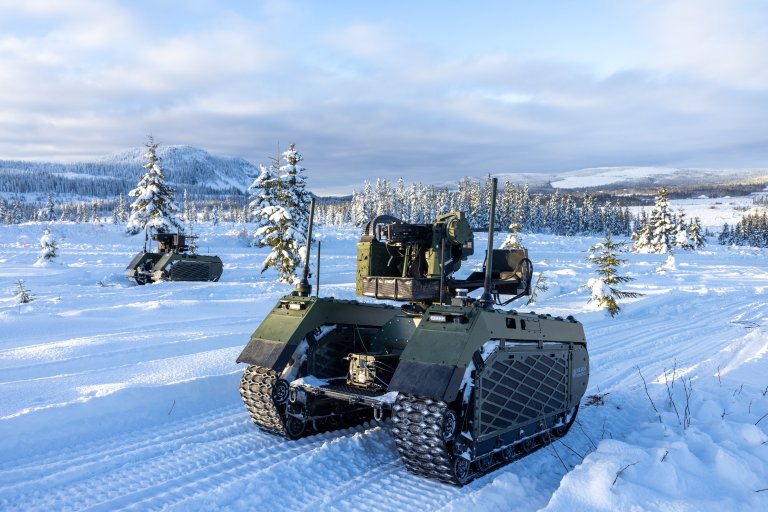
Imagine a swarm of small, unmanned vehicles moving through the forest. They carry different weapons and sensors, and their objective is to defeat an intruder. Along the way, they detect and shoot down a wave of surveillance and attack drones sent out by the enemy.
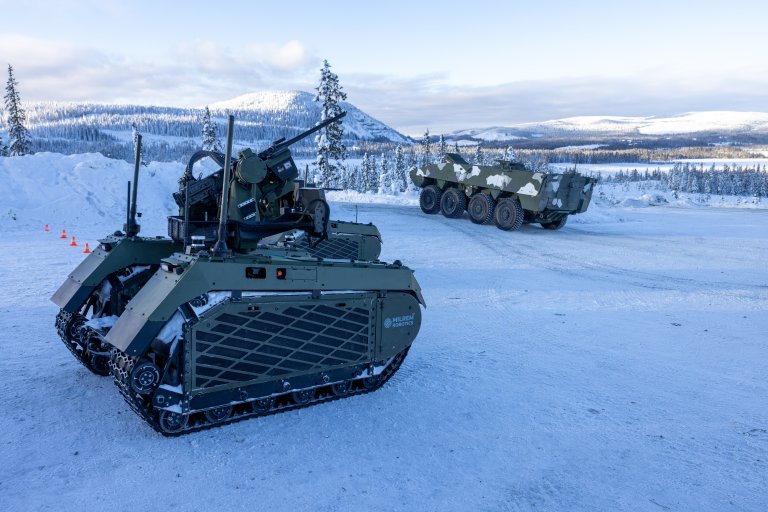
A larger unmanned vehicle equipped with a mortar supports the attack operation from a rear position. The team controlling all the vehicles sits in an armoured vehicle several kilometres away.
Parts of such a scenario were demonstrated at the live fire range area Regionfelt Østlandet in early February. The demonstration was organised by the European Defence Agency (EDA).
Through the CUGS (Combat Unmanned Ground Systems) project, EDA is working to solve the practical and technological challenges related to using autonomous and unmanned combat vehicles.
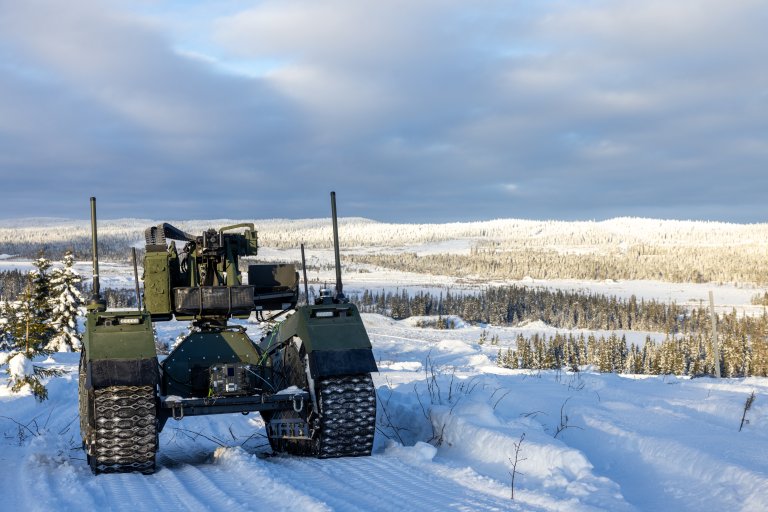
Norway is represented by FFI and KONGSBERG. Our contribution is a KONGSBERG weapon station and drone radar mounted on the THeMIS vehicle from Estonian Milrem Robotics.
Bridging systems
The demonstration at Rena was the first of two demonstrations in EDA CUGS in 2026. Researcher David Kolden from FFI coordinated the Norwegian demonstration. He acknowledges that not everything went smoothly.
‘Even agreeing on the language is complicated. Words and concepts are interpreted very differently. This means we have to spend a lot of time discussing and specifying things in very high detail. And even then, misunderstandings and mistakes still occur. There has been a significant human factor here that has taken a lot of time,’ Kolden says.
‘This is the early beginning of a combat system using UGVs. Our job has been to make several different systems from several manufacturers work together. A typical problem is that the interface on some vehicles or subsystems is incompatible with the system that controls the operation. So we have to create ‘bridges’ and adaptations.’
He explains that they have developed some basic principles, or ‘enablers,’ which they will bring forward into the next iteration.
‘There’s a lot of work left and a long road ahead. On a positive note, though, we are directly connected to the operational needs of the participating nations. That means we know this will be useful once we make it work.’
Not ‘expendable’ technology
There are many practical and technological problems that must be solved before unmanned vehicles, or UGVs, can be used with weapons in combat like this:
- Navigation. The vehicles must be able to navigate and move autonomously through the terrain while the enemy attempts to jam, sabotage, or hinder them.
- Communication, command, and control. Such an attack operation involves vehicles, weapons, and sensors from a wide range of manufacturers. Systems from different manufacturers are often incompatible. How should the vehicles be controlled and cooperate in an operation without requiring too many operators? How should communication between operator, vehicle, and weapon station be handled?
- Weapons use. How can we ensure effective and safe use of weapons when the gunner controlling the weapon is located elsewhere?
Lieutenant Colonel Sven Bjerke at FFI believes that UGVs can make operations more effective and less risky for the Armed Forces in the future.
‘We’re still far from that scenario today. Many challenges remain. But this demonstration is a small step along the way,’ Bjerke says.
‘A system with unmanned vehicles is highly dependent on communication. And as we know, communication is very vulnerable,’ he emphasises.
‘In the lead-up to the demonstration, we saw that communication was disrupted by interference even when no one was trying to jam or sabotage it. These are exactly the kinds of problems we’re here to solve.’
Bjerke notes that the price of a UGV increases as the technology becomes more advanced.
‘We can’t think of such systems as disposable technology. That means we must bring the system up to a level where it actually works very well: Navigation must work well. Command and control must work well. The solutions for detecting and tracking enemy targets must work well. These are all prerequisites for unmanned vehicles to become a major breakthrough in combat situations.’
UGVs for logistics
Bjerke believes the work in EDA CUGS shows that interoperability will remain challenging as long as industry actors do not use open standards that enable simple integration.
‘This is a proof of concept where we connect systems to show that they can function in Norwegian winter conditions. Our work must be followed up by the industry itself, and by potential customers financing further development,’ Bjerke says.
He believes we will see UGVs used in logistics, surveillance, and medical support before we see them in combat.
‘UGVs can have many functions. They can carry ammunition, evacuate wounded personnel, and transport equipment to the front. The technology is already good enough to use UGVs as transport vehicles on fixed roads or fixed routes. The challenges arise when we want UGVs to move through terrain while combining route-finding with a speed that doesn’t expose them too much or too long,’ Bjerke notes.